The blog for conversion of vintage BMW 3.0 CS coupes to Tesla powered electric vehicles
The Transplant is Successful
Get link
Facebook
X
Pinterest
Email
Other Apps
-
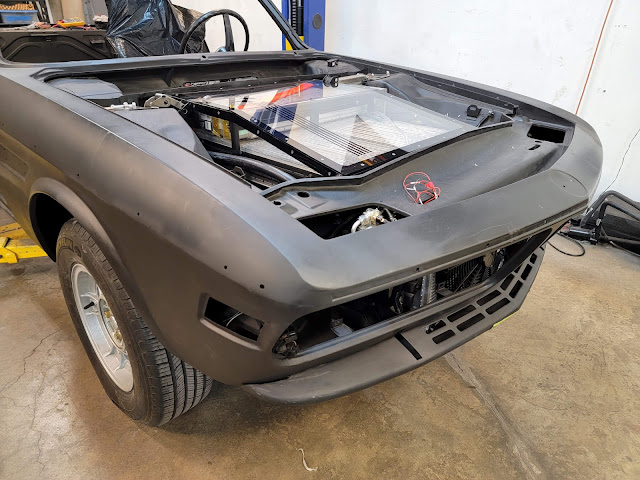
I've successfully transplanted all the components from the donor Tesla Model S into my 1973 BMW 3.0 CS coupe. The last organs to be inserted were the 10 battery modules up front. Now, all 14 batteries are in place, the motor, inverter, and differential unit is installed, the iBooster is operational, and even the Tesla electric air conditioning compressor is in place.
Tesla drivetrain fully installed
I slid in all the batteries, wired them all up, and made some cooling manifold mounts. After failing to keep my cool previously, I rerouted all the battery cooling lines in parallel using a couple 10 port manifolds so the box is all ready to be connected to the radiators. Once everything was in place and hooked up, I installed the acrylic skin and put the box on the winch.
Ready for installation
All wired up
Cooling hoses all connected
Needs a small adjustment to get the strut bars to fit
No extra room on the right, just enough for the A/C hoses
A perfect fit
No extra room on the left
I was able to lower the battery box into the car quite easily, all my myself one evening. It went in like butter. There's no extra room in the engine compartment but everything fits like it should (See below).
You've read about the fancy digital dash app I've written that displays all sorts of information on a display in the hole that used to belong to the tachometer. But that still leaves four other analog gauges in the instrument panel: The speedometer, clock, fuel, and temperature gauges. These are old school VDO gauges that just look proper and cool so I want to make them all work with this new digital vehicle.
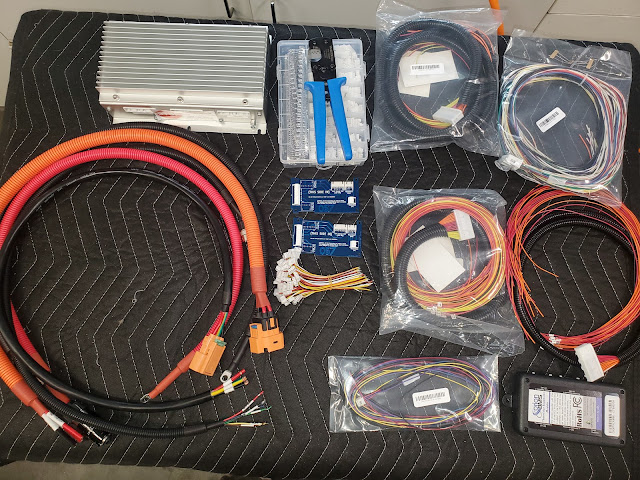
As mentioned previously, careless treatment of the Tesla battery modules can be catastrophic, leading to fire or other failure. Therefore, it is important to monitor the state of the cells to assure they are in proper temperature and charge or discharge. To do this, a Battery Management System (BMS) is required. I'm using the popular Orion BMS 2. The BMS protects and monitors a battery pack by monitoring several sensors and using several outputs to control charge and discharge into the battery. The BMS measures inputs from cell voltage taps, a hall effect current sensor, and thermistors. Using the programmed settings, the BMS then controls the flow of current into and out of the battery pack by broadcasting charge and discharge current limits via the CANBUS to the OnBoard Charger (OBC). During and immediately after charging, the BMS will balance the cells using internal shunt resistors based on the programmed settings.
The onboard charger and battery management system have been in the car for a while but until today I had no way of adding electricity to the car. I bought a J1772 receptacle a while back but hadn't got around to fabricating a way to mount it to the car.